Yesterday I was looking around the lab at all of the things that would have been the major component of someone from yesteryear's researching efforts. There's a little bit of history where ever you turn, like me coming across cases full of electrical equipement, previously used to measure fetal heartbeats - complete with 5¼″ floppy drive. I doubt that anybody now knows how to use and analyse the results from these!
Then I came across this gem:
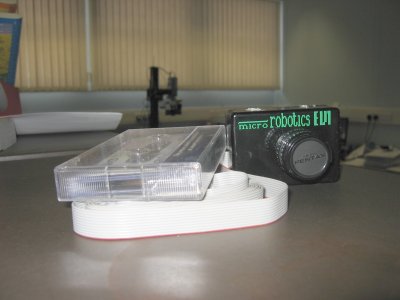
It's a really ancient digital camera - complete with driver software on cassette! I wonder how many pixels it has!
In the background of the photo you can see the silhouette of the uber camera I'm using to collect data for my PhD. I wonder whether that'll end up hidden away in the lab somewhere, with people in 20 years posting about it on their blogs about how amature it looks!
Wow cool i love old stuff like that - where on earth did you find it?
Posted by: Beka on March 26, 2005 3:03 PMIn a box in my lab on a filing cabinet.
Woo Beka!
Posted by: Ed on March 26, 2005 3:05 PMAm wanting to have a look at some weird close up photos of blood... It's the artist in me, I can't help it...
So want one of those cameras!
x
Posted by: Beka on March 26, 2005 3:11 PMHi,
I just found this page doing a bit of nostalgic digging... I was actually one of the designers of this thing at Micro-Robotics - I did some of the BBC software that is on that tape!
This link gives some more history and some specs:
http://www.mjpye.org/camera.shtml
Micro-Robotics still exist ( http://www.microrobotics.co.uk ) but I doubt anyone still there remembers this!
Basically, it's a DRAM chip with the top sliced off - a kind of early CCD - and a cheap lens. The light makes the memory cells discharge quicker... Basically what happens is you fill the RAM full of ones, then wait a certain time (the 'exposure'), and then read it back out again - anything that has gone to zero is 'lit'. If you read it multiple times you can get a kind of gray-scale.
IIRC correctly, the software on the tape included some primitive shape recognition software (not mine, I'm afraid) - one of the ways this was used was to recognise knives and forks coming out of an airline dishwasher - and obviously something in your lab!